The question behind the research
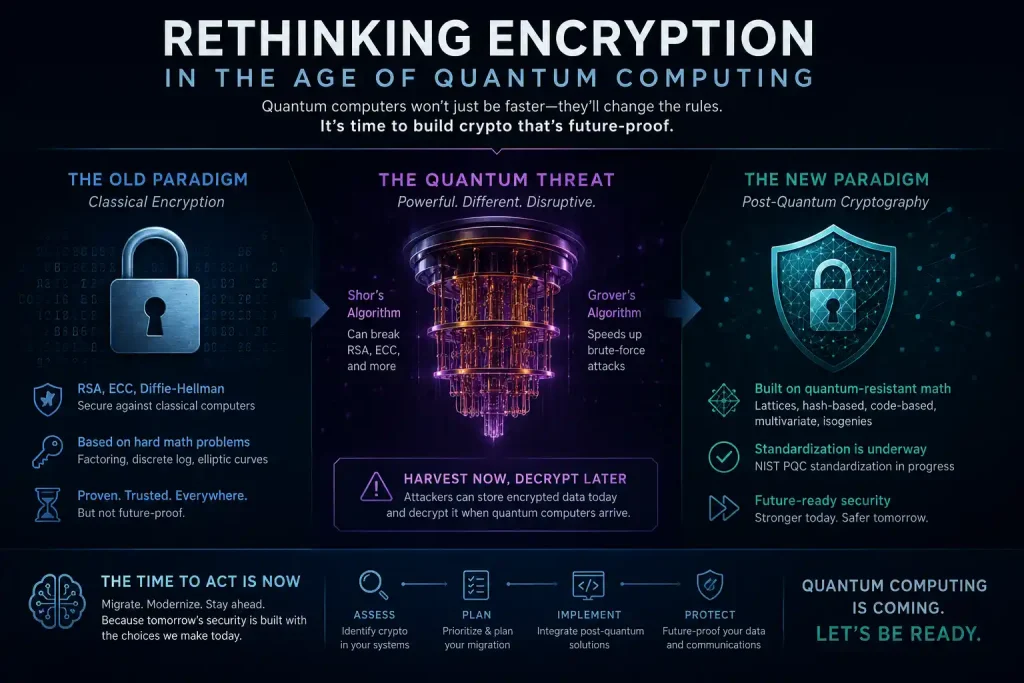
Quantum computing is often introduced as a threat to familiar public-key cryptography. That framing is useful, but it can also narrow the discussion too early. My starting question is broader: if computational capability changes dramatically, how should secure communication itself be redesigned? I am exploring this as a research problem rather than presenting a finished cryptographic system.
From replacement to architecture
Post-quantum algorithms are an important part of the transition, but an enduring security design also has to consider key lifecycle, identity, data classification, migration, recovery and the cost of changing systems that are already deployed. A strong future-facing architecture should make algorithm replacement possible without forcing an entire application stack to be rebuilt.
What I am testing
The work is currently focused on concepts that separate sensitive functions, reduce unnecessary exposure and make cryptographic components easier to change. I am also documenting where assumptions enter the design, because an assumption that is invisible today can become a weakness when computing models change.
A practical direction
For organizations, the immediate lesson is not to wait for a dramatic quantum event. Inventory important cryptographic dependencies, identify data that must remain confidential for many years, and design new systems with crypto-agility in mind. The objective of this project is to turn those principles into a framework that can be tested and explained clearly.
Research status
This remains an early research and experimentation project. Future journal updates will separate theory, implementation tests, limitations and practical applications so that each claim can be evaluated on its own evidence.